Laser cleaner prices confuse buyers for one specific reason: a 300 W machine can cost more than a 2000 W machine, and nothing on the spec sheet explains why. The answer is the laser source, not the wattage. This guide lays out the price bands, explains the pulsed premium, adds the running costs that make the economics unusual among industrial machines, and finishes with which band fits restoration shops, fabricators, and maintenance teams.
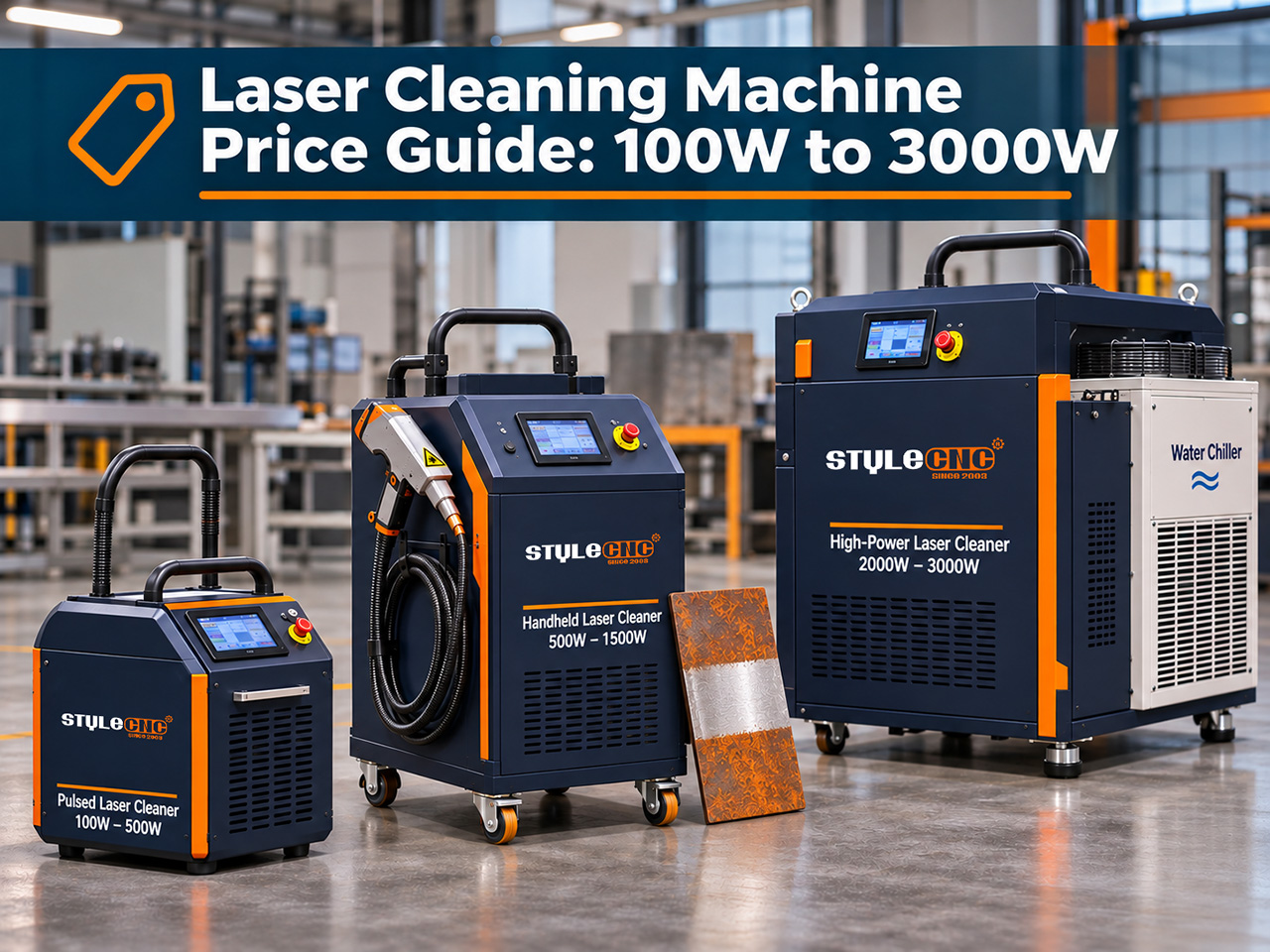
Why a Lower-Watt Machine Can Cost More
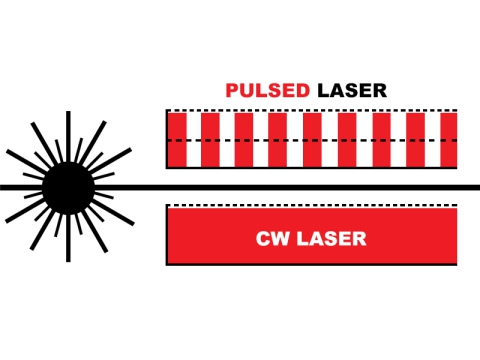
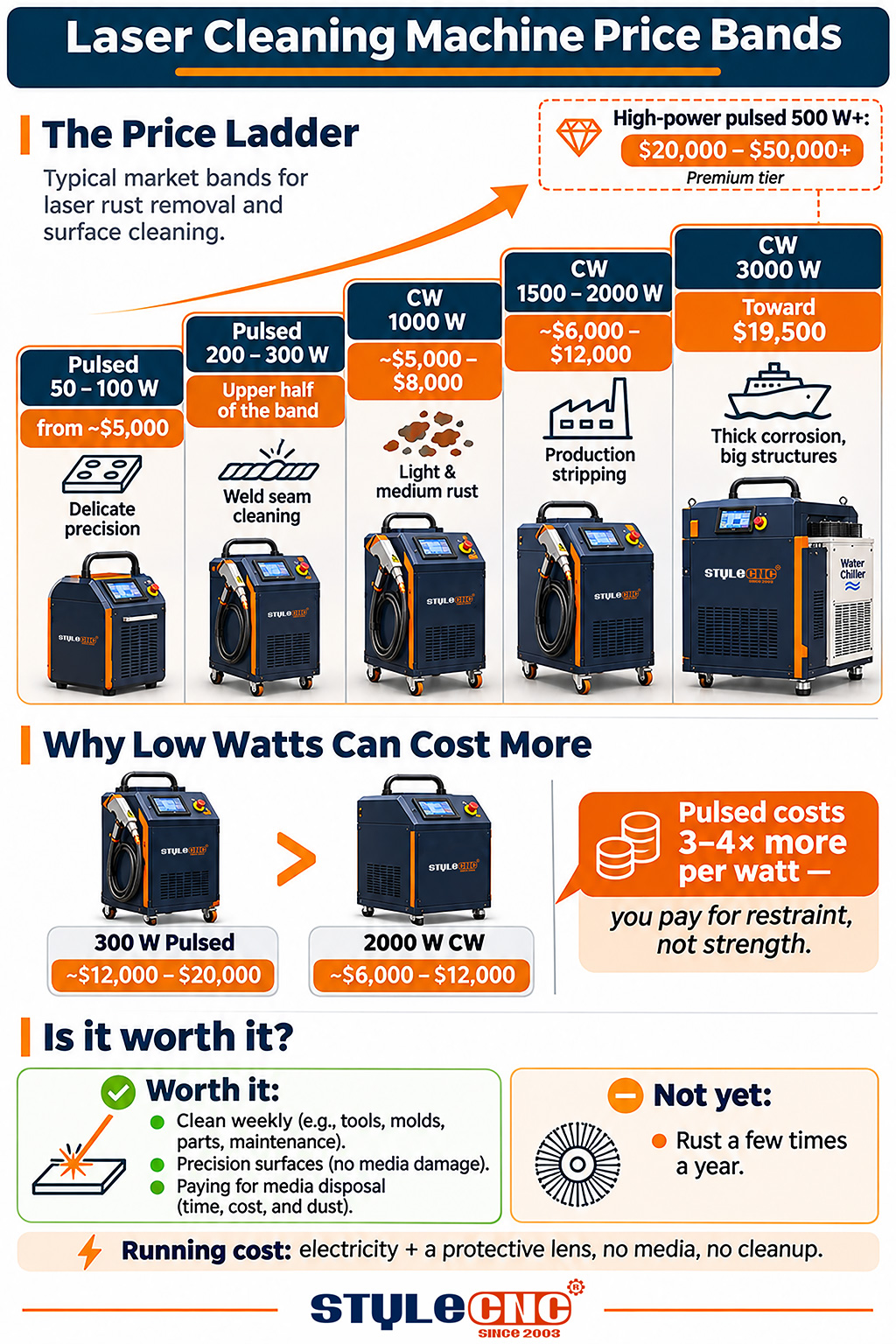
The 1st number on any quote reflects the source type. Continuous-wave fiber sources are the same mature technology that powers cutting and welding machines, produced at volume and priced accordingly. Pulsed sources add the electronics that compress energy into brief, intense bursts, and that capability costs several times more per watt, commonly 3 to 4 times the continuous-wave price at similar power.
You are not paying for strength; you are paying for restraint. The pulse delivers its energy and stops before heat soaks into the base metal, which is what lets a pulsed machine clean a mold cavity or an aluminum casting that a continuous beam would discolor. If your surfaces can tolerate warmth and a working finish, the continuous-wave discount is yours to take. The physics behind the difference is covered in the laser rust removal machine guide, which pairs with this price breakdown.
What else moves the quote
Within a source type, 4 items explain most of the spread between 2 quotes at the same wattage. The laser source brand matters, since premium fiber sources carry documented lifetime ratings and cost more than generic ones. Cooling adds a line: higher powers need a water chiller, while some lower-power units run air-cooled and save the cabinet. The scanning gun varies in scan width and build quality. And portability costs money in both directions: suitcase and backpack formats charge for compactness, while cart systems charge for capacity.
Read quotes for what they include. A complete package carries goggles rated for the wavelength, safety signage, a spare protective lens or two, and shipping; a stripped quote that looks cheaper often rebuilds the difference in accessories after the deposit.
Price Bands by Source and Power
The bands below reflect the current laser cleaning machine range, nke na-esi na $5,000 na $19,500 across pulsed and continuous-wave models, with wider market context where a class extends beyond it:
| Klas igwe | Ahịa Band | What It Cleans | Mgbu | mmesho |
|---|---|---|---|---|
| Pulsed, 50 to 100 W | From about $5, 000 | Delicate precision work: molds, instruments, spot cleaning | Careful and slow | Finish quality on your most sensitive surface |
| Pulsed, 200 to 300 W | Upper half of the range | Molds, weld seams, restoration at a working pace | Otu ebe | Square meters per hour on light rust |
| CW, 1000 W | From about $5,000 na $8, 000 | Light and medium rust, thin paint on steel and iron | fọrọ nke nta | Passes needed on your typical rust grade |
| CW, 1500 to 2000 W | O siri ike $6,000 na $12,000 | Production stripping, heavier rust and coatings | Ọsọ ọsọ | Okirikiri ọrụ n'ofe mgbanwe zuru oke |
| CW, 3000 W | N'akuku $19,500 | Thick corrosion, large structures, marine and plant work | Ngwa ngwa | Total cleaning hours per month the class saves |
Above this range sits a premium tier the market quotes separately: high-power pulsed machines of 500 W and up, which combine near-continuous speed with pulsed gentleness at $20,000 ka $50,000 and beyond. They exist for aerospace parts, high-value molds, and production lines that need both pace and precision; most first-time buyers never need the tier, and knowing it exists mostly explains the startling quotes that circulate in forums.
Used machines and very cheap imports
2 tempting detours deserve caution. Secondhand units price well but carry an unknowable history on the one component that dominates the machine's value, the laser source, and a replacement can cost more than the used machine did. Ultra-cheap imports at a fraction of the normal band usually economize on the source, the safety interlocks, or both; with a Class 4 device, the interlocks are not where to save. If the budget is tight, a smaller machine from the normal band beats a bigger machine from below it.
Running Costs: The Unusual Part of the Economics
Most industrial machines carry a long consumables tail. Laser cleaners barely do, which changes how the purchase price should be read:
⦿ Electricity: a handheld unit draws a few kilowatts; at typical tariffs, an hour of cleaning costs well under a dollar in power.
⦿ Consumables: a protective lens on the gun and little else; there is no media, no chemical bath, and no grit disposal fee.
⦿ Maintenance: fiber sources are rated for tens of thousands of hours; routine care is keeping optics clean and filters clear.
⦿ Labor: one operator, no suiting up, no masking time, and no cleanup shift after the work.
This is why the payback conversation differs from blasting equipment. A blasting cabinet is cheap to buy and expensive to feed; a laser cleaner inverts that. The full operating comparison, including media and disposal lines, is worked through in the laser rust removal cost analysis, and it is the right companion read before building your own numbers.
Comparing cost per cleaned square meter
For a fair comparison across bands, divide each machine's price by the square meters it will clean over, say, 5 years of your workload. A 2000 W machine at roughly half again the 1000 W price that cleans more than twice as fast wins that arithmetic easily for a busy shop, while an occasional user never recovers the difference. Price per watt flatters the big machines; price per cleaned meter tells the truth for your volume.
A Payback Sketch Against Outsourced Blasting
An illustrative maintenance operation sends parts out for blasting at $500 a week, about $26,000 a year across charges, freight, and the schedule delays that follow. A 1500 W continuous-wave cleaner near the middle of its band, at roughly $8,000 installed, replaces most of that spend for the cost of electricity and an operator's time the shop already pays for.
Even assuming only 2 thirds of the outsourced work moves in-house, the machine returns its price within the 1st year, and every year after that banks the difference. Swap in your own blasting invoices, or your internal blasting bay's media, labor, and disposal costs, and the arithmetic takes ten minutes. Shops cleaning precision surfaces should run the same numbers against the pulsed bands; the premium is real, but so is the scrap a hot beam would create on a mold.
Is laser cleaning worth it?
The question behind every price search has a conditional answer. Worth it: shops that clean weekly or daily, clean surfaces that blasting would erode or chemicals would contaminate, or pay real money for media disposal and masking labor. Not worth it yet: shops that fight rust a few times a year, for whom a wire wheel and a weekend remain unbeatable economics. The machine earns money through frequency; occasional use only earns it admiration.
Which Band Fits Which Buyer
⦿ Restoration shops and fabricators with mixed rust work: the CW 1000 to 1500 W bands cover light and medium corrosion at the friendliest prices.
⦿ Heavy fabrication, plant maintenance, and marine: CW 2000 to 3000 W earns its premium in square meters per hour on thick corrosion.
⦿ Mold shops, toolrooms, and precision cleaning: pulsed 100 to 300 W, because the surfaces are worth more than the speed.
⦿ Production lines needing both speed and gentleness: the high-power pulsed tier, priced accordingly and justified by part value.
Before deciding, look at what each class produces: the ụlọ ọrụ ihe ngosi igwe nhicha laser shows finish quality across rust, paint, and oxide jobs, and the laser cleaner customer reviews report how the bands performed for shops at different volumes, including where buyers wished they had sized up or saved money sizing down.
One final sizing note: buy for the backlog, not the showcase part. A machine sized to your weekly square meters with a little headroom beats both the underpowered bargain that turns every job into 3 passes and the flagship that idles between occasional tasks. The quote request should state your materials, rust grades, and weekly hours; a supplier who sizes from those numbers is doing the engineering a brochure cannot.
Ndepụta Ndị Zụrụ Ihe Tupu Ị Kwuo Okwu
✔ Decide pulsed or continuous-wave first; it moves the price more than any watt figure.
✔ List your surfaces by sensitivity: anything that cannot tolerate heat or discoloration points to pulsed.
✔ Size CW power to the square meters you clean weekly, and demo the machine on your worst part.
✔ Price the full package: gun, source, goggles, safety screens, and fume extraction.
✔ Run the payback against your current blasting or chemical spend, including disposal and delays.
Nweta ọnụahịa dabara na otu egwu gị
Compare pulsed and continuous-wave models across the full range of igwe nhicha laser, and get a free quote sized to your surfaces, rust grades, and weekly cleaning hours.